Scaling Fintech Infrastructure for High-Volume Transactions
How we approach building resilient, high-throughput payment systems that don't drop transactions during peak loads.
When building standard web applications, a dropped request or a 502 Bad Gateway is an inconvenience. The user refreshes the page, and life goes on. In fintech, the stakes are fundamentally different. A dropped request during a checkout flow isn't just a bad user experience—it's missing money, duplicated charges, and broken trust.
Over the last few years of building financial platforms, we've standardized a specific architectural pattern for handling high-volume transaction loads. It relies on three core pillars: strict idempotency, asynchronous processing, and ledger immutability.
The Idempotency Key Pattern
Network failures are inevitable. A mobile client might send a payment request, lose connection before receiving the success response, and automatically retry the request. If your backend processes both requests, you've just double-charged the user.
To solve this, every state-mutating request must include an Idempotency-Key header. Before doing any work, the API checks a fast, in-memory cache (like Redis) to see if this key has been processed.
async function processPayment(req: Request) {
  const idempotencyKey = req.headers['x-idempotency-key'];

  // 1. Acquire a distributed lock for this key
  const lock = await redis.set(idempotencyKey, 'processing', 'NX', 'EX', 30);
  if (!lock) {
    return await redis.get(idempotencyKey); // Return cached response
  }

  try {
    // 2. Enqueue the payment for async processing
    await sqs.sendMessage({
      QueueUrl: PAYMENT_QUEUE,
      MessageBody: JSON.stringify(req.body),
      MessageGroupId: idempotencyKey
    });

    return { status: 'accepted', message: 'Payment queued' };
  } catch (error) {
    await redis.del(idempotencyKey); // Release lock on failure
    throw error;
  }
}
Decoupling with Message Queues
Notice in the code above that the API doesn't actually process the payment. It just puts it in a queue and returns a 202 Accepted. Why?
"Your primary database should never be the bottleneck for accepting a customer's money."
During a massive traffic spike (like a flash sale or a ticket drop), synchronous database writes will eventually lock up. Connection pools exhaust, CPU spikes, and the API goes down. By decoupling the ingestion from the processing, the API Gateway can absorb massive bursts of traffic and safely store them in a queue (like AWS SQS or Kafka).
Architecture Overview
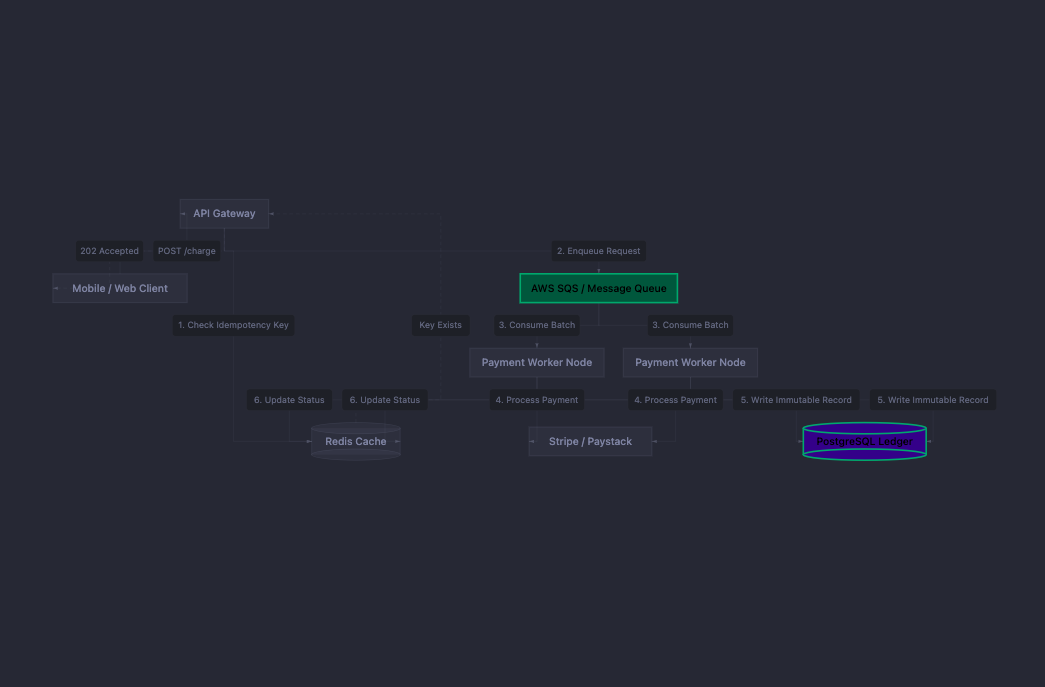
In this architecture, dedicated Worker Nodes pull from the queue at a controlled rate. They handle the slow, error-prone work: talking to third-party payment gateways (like Stripe or Paystack), handling retries, and writing the final immutable records to the PostgreSQL ledger.
If the database goes down for maintenance, or the third-party provider has an outage, the API stays up. The queue simply builds up, and the workers drain it once the downstream services recover. No transactions are lost, and no users see an error screen.